
Anglophone Postcolonial Studies
Anglophone Postcolonial Studies explores cross-cultural encounters and negotiations in historical and contemporary contact zones in Africa, the Caribbean, South Asia, Southeast Asia, and the Pacific, Canada, the USA, Australia, and New Zealand, and in diasporic contexts throughout the Anglophone world. Postcolonial theory constitutes an important frame of reference for the book series. Anglophone Postcolonial Studies is open to research that critically examines the history and legacies of colonialisms in various frames of reference, from local to global phenomena, as well as social and cultural processes of transformation that reach beyond this nexus.
The volumes in the series explore a wide range of regional, cultural, and historical issues in World Anglophone and Postcolonial Studies and provide free worldwide access to current research in these areas.
Anglophone Postcolonial Studies is edited by the Gesellschaft für Anglophone Postkoloniale Studien e.V. (GAPS)
Association for Anglophone Postcolonial Studies
Editors
Eric Anchimbe
Nadia Butt
Timo Müller
Cecile Sandten
Coming Soon

Postcolonial Infrastructure
Colonization is not least an infrastructure project. It involves the destruction of indigenous infrastructure and the transcultural transfer of military, political, social, and other infrastructure to establish and maintain power over colonized peoples. At the same time, infrastructure has emerged as a key site and means of resistance in the decolonial struggle. In this volume, fourteen scholars from literary and cultural studies, linguistics, musicology, and the environmental humanities explore this underrepresented yet essential dimension of colonial, postcolonial, and decolonial life.
Published so far

Contested Solidarities: Agency and Victimhood in Anglophone Literatures and Cultures
This volume responds to the multiple forms of oppression and their manifold casualties in the Global South, without taking recourse to a preemptive normativity promising instant identification of victims and perpetrators. It explores critical, self-reflexive, and disenchanted rather than organic, blanket, or mesmerized forms of solidarity. It further investigates literature and culture beyond habitual victimological frameworks as sites of unruly, unexpected, and unpredictable agency. The edited collection of essays provides impressive examples of such work engaging with a wide array of narrative forms—from novels, short fiction, life writing, and poetry to performance, documentary, film, and museum exhibitions—cutting across an equally wide array of contexts ranging from Cameroon, Ethiopia, Ghana, and India to Kenya, the Middle East, Poland, Sri Lanka, South Africa, the UK, the USA, and Zimbabwe.
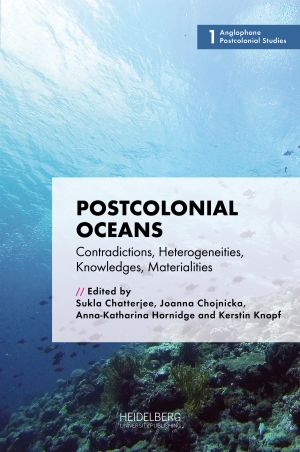
Postcolonial Oceans: Contradictions, Heterogeneities, Knowledges, Materialities
This book contributes to the study of oceans, seas, coastal waters, and rivers within blue humanities by broadening, circulating, and interweaving knowledge about such waters, ocean epistemologies, and sea narratives from pluriversal epistemological, geographical, cultural, and disciplinary perspectives. The contributors from Africa, Asia, the Caribbean, Europe, North America and the Pacific explore the interconnections between oceans, coastal areas, rivers, humans, animals, plants, organisms, and landscapes in the fields of cultural history and cultural studies, critical race and postcolonial studies, marine and environmental studies, linguistics, literature, film and media studies.

Science, Culture, and Postcolonial Narratives
From climate change to global pandemics, some of the most vexing questions facing postcolonial societies are entangled with the contradictory role of science in postcolonial contexts. Science is connected to histories of colonial oppression but also to promises of improvement and emancipation; it may be the cause of environmental degradation but also its remedy. This volume engages with the cultural imagination of science and problematises the role of narrative at the intersection of culture and the sciences. Bridging postcolonial studies, literature and science studies, and other traditions, the contributors examine cultural narratives as well as texts from 19th-century utopianism to postcolonial 'science novels' and contemporary science fiction.